

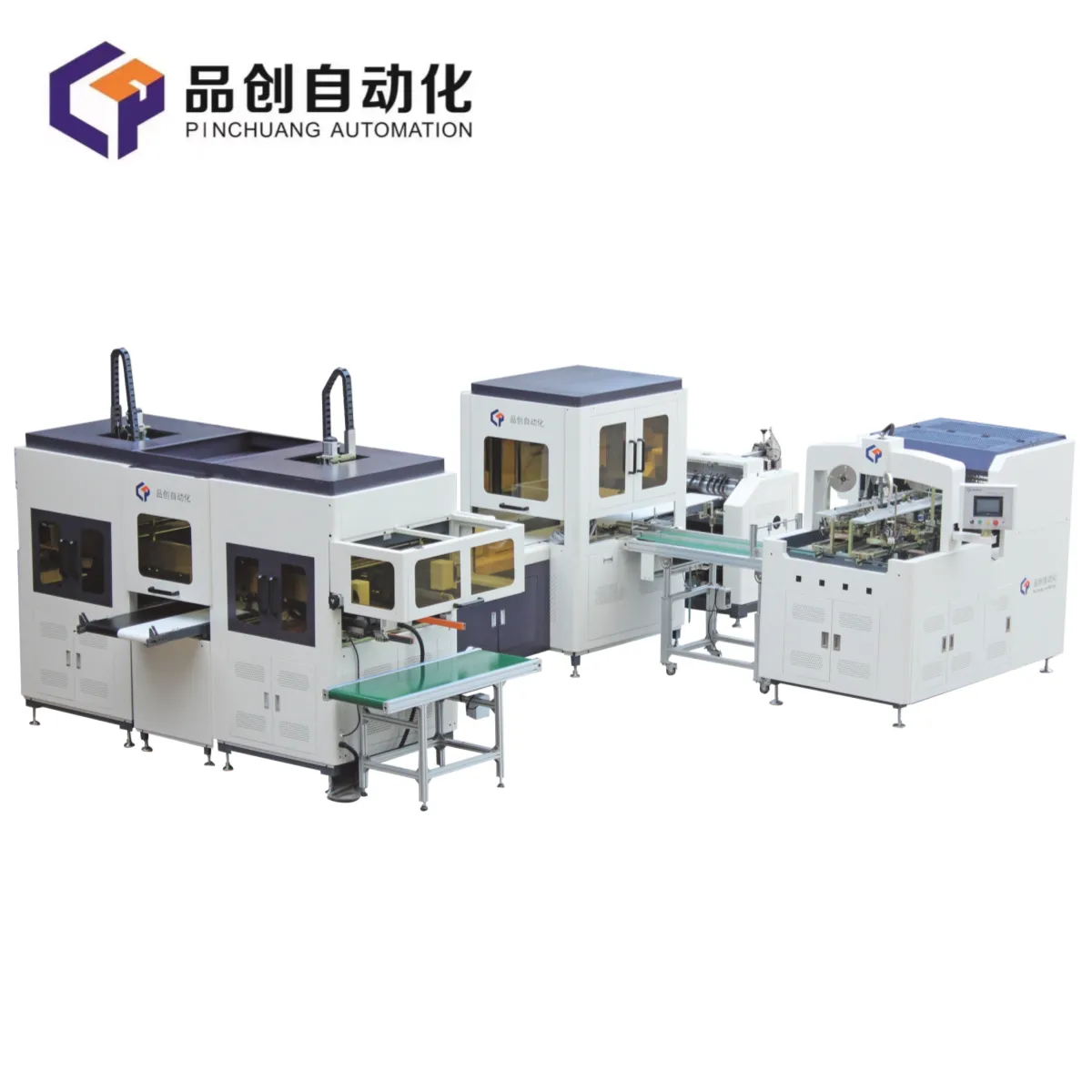
A rigid box making machine is the equipment that turns flat greyboard and printed wrap paper into a finished three-dimensional box — the packaging used for phones, jewellery, watches, cosmetics and gift sets. In short, it glues the wrap to the board, turns the four sides in, and forms the panels so that the finished box holds its shape and never collapses.
At Pinchuang, we have been building rigid box making machines in Dongguan since 2008. This guide explains what the machine actually produces, the stations inside it, how a single box is built from board to finished product, and the three accuracy points that decide whether a box looks premium or ordinary. If you are comparing suppliers or planning a line, the specification section toward the end gives you real numbers from our current catalogue rather than marketing language.
What a Rigid Box Making Machine Actually Produces
The most common mistake buyers make is mixing up a rigid box with a folding carton. Both are made of paper, both are called boxes, and in a photograph they can look almost identical. They are produced in completely different ways, and they serve completely different price points.
| Feature | Folding carton | Rigid box |
|---|---|---|
| Raw material | One sheet of paperboard | Greyboard core plus printed wrap paper |
| How it is made | Creased and folded | Glued, wrapped and formed |
| How it ships | Flat and folded | Assembled, non-collapsible |
| Hand feel | Light and flexible | Heavy and solid |
| Typical end use | Cereals, pharma, fast-moving consumer goods | Phones, jewellery, cosmetics, gift sets |
An automatic rigid box making machine builds the right-hand column. Every station on that machine — gluing, wrapping, grooving, corner pasting, forming — exists to keep the board flat, the wrap tight and the corners sharp. Nothing on the machine is decorative; each step protects one of those three things.
That is also why rigid box output is measured in boxes per minute rather than in tonnes. The real output of a line depends far more on how quickly it changes size and how well it holds alignment than on how fast it can run in a straight line with one box size.
The Core Stations Inside a Rigid Box Making Machine
Strip the covers off and every rigid box making machine is a short sequence of stations. The number of stations changes between models, but the sequence itself does not.
- Paper feeding — the printed wrap is lifted sheet by sheet and delivered to the gluing station.
- Gluing — an even adhesive film is applied across the wrap. Uneven glue is the single most common cause of bubbles and lifting corners.
- Board feeding — greyboard is fed from a stack, typically up to 1,000 mm high on production models.
- Wrapping — the glued wrap is pressed onto the board and the four sides are turned in.
- V-grooving — a V-shaped channel is cut so the board folds cleanly instead of cracking.
- Corner pasting — corner flaps are taped and pressed so the box keeps its shape under load.
- Forming — the flat wrapped panel is pushed into a mould and becomes a three-dimensional box.
- Positioning — a vision system corrects the wrap position before gluing, so the printed pattern lands where the designer intended.
On a fully automatic line these stations run as one continuous flow. On a semi-automatic setup they are separate units and an operator moves product between them. The rigid box forming machine is the station most buyers ask to see first, because it is the one that physically decides whether the finished box is square.
How One Box Is Built: Greyboard, Gluing, V-Grooving, Corner Pasting, Forming
It is easier to understand the whole line by following a single phone box through it. This is the sequence I walk customers through during a factory visit.
- Greyboard is cut to size. On premium work it is grooved at the same stage, so each fold line has a channel instead of a crease.
- The wrap is fed and glued. Adhesive film thickness and roller pressure are set once and then monitored; an automatic paper gluing machine keeps that film even across the full sheet.
- The board is placed on the glued wrap. Position is set by the machine rather than by hand, which is what makes the result repeatable.
- The wrap is turned in on all four sides. Turn-in depth, typically 10–80 mm, is matched to the box height.
- V-grooving cuts the fold channels. On a dedicated automatic V grooving machine blade depth is the critical setting: too shallow and the board cracks when folded, too deep and the blade cuts through the surface.
- Corners are pasted. An automatic corner pasting machine applies tape to the four corner flaps, and that tape is what stops a rigid box from springing open months later.
- The wrapped panel is loaded into the forming station and pressed into a mould. This is the moment a flat sheet becomes a box with a base and four walls.
A finished rigid box therefore has two visible quality markers: a tight, even wrap and four sharp corners. Every step upstream either protects those two things or threatens them.
Three Accuracy Points That Decide Final Box Quality
Buyers usually ask about speed first and accuracy second. In practice, accuracy is what they end up discussing with their own customers. Three settings matter more than the rest.
1. Wrap alignment and visual positioning
When a printed pattern has to sit centred on the box lid, mechanical stops are not enough. Size changes, textured wrap and small paper distortion all shift the pattern by a millimetre or two. An automatic visual positioning machine reads the printed marks and corrects position before gluing, which is why visual positioning has become standard on equipment aimed at cosmetics and gift packaging.
2. Corner pasting depth
Corner tape that is too short leaves the box weak at the corners; tape that is too long can show through the wrap. Corner pasting depth should be set together with the box height, and it has to stay repeatable across a full production run without an operator adjusting it box by box.
3. V-groove depth and fold quality
A groove that is even across a 500 mm panel folds cleanly. One that is not will either show a line on the wrapped surface or crack the board. This is the setting that most often exposes the difference between a machine with servo-controlled groove depth and one without.
On our current production models the stated positioning precision is ±0.1 mm at machine level, and that figure is what the accuracy settings above are built around.
What a Rigid Box Making Machine Can Handle: Board, Size and Output
At Pinchuang, specifications matter most when two models come from the same platform. The table below uses the published figures for our two most common rigid box machines, so you can see exactly how a shared platform changes with configuration.
| Parameter | PC-5040A | PC-5040B |
|---|---|---|
| Max. box size | L 500 × W 400 × H 120 mm | L 500 × W 400 × H 120 mm |
| Min. box size | L 65 × W 65 × H 15 mm | L 65 × W 65 × H 15 mm |
| Cardboard thickness | 1–3 mm | 1–3 mm |
| Wrap paper thickness | 80–200 g/m² | 80–200 g/m² |
| Production speed | 26–40 pcs/min | 16–25 pcs/min |
| Positioning precision | ±0.1 mm | ±0.1 mm |
| Machine dimensions | L 8200 × W 6000 × H 2150 mm | L 8200 × W 4200 × H 2150 mm |
Both models cover the same box range and the same board thickness. The difference sits in station configuration and output. PC-5040A is a high-speed configuration built around a two-piece box forming arrangement; PC-5040B is a basic fully automatic line that combines corner pasting, box forming and positioning on one platform. Choosing between them is normally a question of order profile rather than box type.
For scale reference, Pinchuang builds this equipment in a 10,000 m² facility in Dongguan with more than 100 employees, and the machines ship to over 30 countries. We have been manufacturing rigid box equipment since 2008, and we exhibit regularly at All in Print China, Printing South China, China Print, Drupa, SINO FOLDING CARTON and WEPACK. The most common request from export buyers is not a faster machine — it is a machine that repeats the same setting after every size change.


The boxes these lines produce end up in a fairly narrow set of product categories — watches, jewellery, cosmetics, spirits, tea, electronics and seasonal gift sets. Looking at the applications we see most often is a faster way to judge whether a given size range fits your order book than comparing specification sheets line by line.
Common Questions About Rigid Box Production
What is the difference between a rigid box making machine and a case making machine?
A rigid box making machine produces a finished three-dimensional box. A case making machine produces a flat wrapped panel — a book cover, calendar cover or album case. The two share the same core process of gluing and wrapping, but they deliver at different points in the workflow, and they serve different customers: packaging plants on one side, bookbinding and print finishing shops on the other.
How many boxes per minute can a rigid box making machine produce?
It depends on configuration rather than on box type. On our current models the published range runs from 16–25 pcs/min on a basic fully automatic line up to 26–40 pcs/min on a high-speed configuration. Real shift output is usually lower than the rated figure, because size changeover and wrap changes take time, and that gap is worth asking about when you compare suppliers.
What board thickness can these machines handle?
The current rigid box platform handles greyboard from 1 mm to 3 mm and wrap paper from 80 to 200 g/m². Very thin decorative wraps and heavier textured papers are both workable, but they need different gluing settings, which is why glue control matters more than most buyers expect at the enquiry stage.
Do I need a complete line or a single machine?
If you already run V-grooving, corner pasting or gluing as separate operations, adding a forming station can be enough. If you are starting from scratch, a fully automatic line is normally the faster route to consistent output, because the stations are matched to each other from the first box.
If you are planning rigid box production and want to know which configuration suits your box range, send Pinchuang your box samples and order profile. Our engineers will tell you which rigid box making machine fits, and which supporting stations you can add later.
Send us your box samples See all rigid box models